
Welcome to Siena’s Contrada del Leocorno – one of the city’s 17 historic districts, known as the Unicorn Contrada. This guide is written for international visitors and uses Hotel Minerva (Via Garibaldi 72) as a convenient starting point. We’ll explore the Unicorn Contrada’s rich history, its symbolism and traditions, practical tips for visiting its museum and landmarks, a detailed list of Palio victories, and walking routes with maps from Hotel Minerva into the heart of this contrada. Whether you’re a curious traveler or a Palio enthusiast, get ready to dive into the unique culture of Siena’s Leocorno contrada in an engaging and accessible way!
Overview of Contrada del Leocorno
To set the stage, here is a quick overview of key facts about the Contrada del Leocorno (Unicorn Contrada) :
- Symbol & Name: The contrada’s emblem is a rampant unicorn on a silver shield bordered in blue, with the Latin motto “Humberti Regis Gratia.” The name “Leocorno” is an old Italian term for unicorn, the mythical creature with a single horn. The contrada’s own motto is “Fiede e risana al par l’arma c’ho in fronte,” which means “It wounds and heals equally, the weapon I bear on my forehead.” This refers to the unicorn’s horn, symbolically capable of both striking foes and purifying waters (healing). The unicorn in medieval lore represents purity, strength, and grace – an idealized guardian spirit for the district.
- Colors: The Unicorn Contrada’s official colors are white and orange, with blue stripes . You’ll see these colors on flags and scarves worn by its members (the contradaioli).
- Location: Leocorno is located in Siena’s Terzo di San Martino (the south-east quadrant of the historical center) . Its territory is a cluster of medieval streets just east of Piazza del Campo, including Via di Pantaneto, Via del Porrione, and their surroundings (detailed later). It’s one of the oldest contrade and is known for its strong community spirit.
- Alliances & Rivalry: Leocorno is traditionally allied with the Pantera (Panther) and Tartuca (Tortoise) contrade . These alliances mean they support each other and do not feud. However, Leocorno has a storied rivalry with the Civetta (Owl) contrada – since 1960 the Owl has been its sole official rival. This rivalry is mostly expressed during the Palio horse races, adding drama to the competition.
- Patron Saint & Feast: The contrada’s patron saint is Saint John the Baptist, whose feast falls on June 24 . Each year around that date, the contrada holds a festa titolare (patronal festival) with religious ceremonies, street celebrations, and a grand contrada dinner. We’ll cover these traditions in detail, but note that late June is a wonderful time to witness contrada life up close.
- Title of “Priora”: The Contrada del Leocorno holds the honorary title of Priora, because it hosted the very first meeting of the Magistrato delle Contrade (the council of all contrade) in history . This prestigious distinction underlines Leocorno’s importance in Siena’s contrada system.
- Historic “Guild”: Historically, each contrada was associated with a trade or craft. Leocorno’s traditional guild is that of the Goldsmiths (Orafi) . This doesn’t have practical function today, but it’s a point of pride linking the Unicorn contrada with the craftsmanship of jewelers.
- Palio Victories: As of 2022, Leocorno has won 31 Palio horse races over the centuries . (We will list all the victories with dates and anecdotes in a later section.) The contrada’s most recent win came on August 17, 2022, breaking a 15-year drought, and it was a spectacular victory with a record track time . Notably, Leocorno has never won both annual Palio races in the same year (a feat known as a “cappotto” in Palio lore) .
With these basics in mind, let’s delve deeper into the history and heritage of the Unicorn Contrada.
The History of the Unicorn Contrada
Like all Sienese contrade, the Contrada del Leocorno has a long and fascinating history that dates back many centuries. We can think of its history in two broad phases – the ancient origins and the modern era – with a turning point around the late 18th century . Throughout its story, this contrada’s identity has been shaped by faith, community, and a little bit of legend.
Origins and Early History (Medieval–18th Century)
The exact origins of the Leocorno contrada are somewhat obscure (as is the case for most contrade), but historians agree the contrade evolved from earlier neighborhood military companies and guilds in medieval Siena . In the area that is now Leocorno, three historical military companies existed – San Giorgio, Pantaneto, and Spadaforte – and their jurisdictions later corresponded to Leocorno’s territory . These companies were like militia units, and according to scholars the contrade became the “festive dress” of these companies – meaning the contrade took on social and celebratory roles even as the military functions faded .
What we do know is that by the Renaissance, the people of this district were already rallying around the Church of San Giovannino della Staffa (Saint John’s Church) as a community hub . This small church, located in what is now Piazzetta Virgilio Grassi (the contrada’s headquarters), became the heart of the contrada’s spiritual life. In the early 1600s, members of the Compagnia di San Giovanni Battista (a lay brotherhood devoted to St. John the Baptist) took care to beautify the church, commissioning important artworks that still adorn it . One of these is the “Madonna della Pace” – a splendid late 14th-century painting of the Madonna and Child by artist Francesco di Vannuccio . They even built a special chapel to house this revered image of the Virgin, known as the Madonna of Peace, which attracted devotion from across Siena .
In 1660, a milestone event occurred: the San Giovanni fraternity formally welcomed the Contrada of the Unicorn into their church. On July 9, 1660, the company granted the contrada use of the chapel and space to meet – essentially giving the Unicorn contrada an official home inside San Giovannino . Contrary to some later tales of conflict, the records show that for about a century the relationship between the contrada and the fraternity was very close and cooperative .
During this early era, a colorful legend was born: after a particularly celebratory Palio victory in 1704, it’s said that the bell tower of San Giovannino collapsed from the furious ringing of the bells in jubilation ! The story goes that the Unicorn contradaioli rang the church’s bells so exuberantly to celebrate winning the Palio that the poor bell tower gave way. (In truth, a document reveals the bells’ ropes were deliberately cut to stop the ringing, and no formal complaint was made against the contrada . Still, the legend of the collapsing bell tower captures the passionate spirit of contrada celebrations.) This 1704 Palio win became part of contrada folklore, illustrating how victory celebrations could literally shake the neighborhood.
By the mid-1700s, the contrada’s earlier history starts blending into more reliable records. In 1776 the Unicorn contrada won a Palio after a very long dry spell – and according to legend, the contradaioli had kept a “legendary fast” until they could finally celebrate a victory . When they triumphed in August 1776, it was said to end a period of vowed fasting or abstinence, underlining how deeply victories were yearned for. From that moment (1776) onward, the contrada’s activities and organization are well documented in its archives .
Shortly afterward, major changes came to all the contrade. In the late 18th century (1770s–1780s), the Grand Duke of Tuscany (Peter Leopold and later Ferdinand III) reorganized and suppressed many of the old guilds and companies. The ancient Contrada of Leocorno effectively “re-founded” itself during this time. Under Prior Pistoi (an innkeeper by trade at the tavern in front of the church) and Prior Costantini (a local priest), the contrada drafted its first written statutes or constitution . They formalized memberships and roles, setting the stage for the modern contrada.
However, the contrada’s relationship with its beloved church had to adjust when those old religious companies were dissolved by ducal decree. San Giovannino was turned into an ordinary parish church (no longer run by the lay fraternity) . The contrada continued to use San Giovannino for meetings, but it was not an ideal situation – they only had the church’s entrance area for gatherings, which wasn’t entirely convenient .
By the mid-1800s, a solution appeared: the Archbishop’s Seminary left the nearby Church of San Giorgio (a larger church at the far end of Via Pantaneto) . Though San Giorgio was technically just outside Leocorno’s territorial borders, both the parish priest and the contrada members agreed it might serve better as the contrada’s base. Thus, around 1855, the Contrada del Leocorno relocated to the Church of San Giorgio and used it as their seat for about a century . During the 1800s, some of the city’s prominent families (especially the Placidi family) and the legendary Prior Grassi supported the contrada, helping it survive through tough times like the structural instability of San Giorgio’s aging building . Despite challenges, Leocorno won numerous Palios in the 19th century (as we’ll list later) and built up its traditions.
By the early 20th century (first decades of 1900s), a strong core of contradaioli had formed around San Giorgio, which laid the groundwork for a major turning point: returning home to San Giovannino .
Modern Era (20th Century – Present)
The modern history of Contrada del Leocorno is defined by a triumphant homecoming and a revival of its infrastructure and spirit. After about 100 years at San Giorgio, the contrada longed to return to its historical roots near San Giovannino. Their chance came in the 1960s. On December 21, 1966, an agreement was signed between the Archdiocese of Siena and the Unicorn Contrada, granting Leocorno the perpetual use of the Church of San Giovannino della Staffa and adjacent premises . This was a monumental achievement: it allowed the contrada to adapt and renovate the old site to serve as its own headquarters and museum, aligning perfectly with its needs .
After several years of preparations, on June 27, 1970, during the feast of St. John, the Church of San Giovannino was officially inaugurated as the contrada’s oratory and home . All the authorities and representatives of the other contrade attended, recognizing it as a historic moment. This marked the true beginning of the “modern” Leocorno: the Unicorn was back in its lair, so to speak, after a long exile.
Returning “home” energized the contrada. In 1970 they also formally established the Contrada Society “Il Cavallino” (The Little Horse) . The “Società di Contrada” is essentially the social club of the contrada – a place and organization for contradaioli to gather, eat, plan events, and nurture the community. Il Cavallino became the heart of Leocorno’s social life, hosting dinners, celebrations, and youth activities.
The next decade brought long-awaited glory: on August 17, 1980, Leocorno finally won the Palio again after a 26-year gap (their previous win was in 1954) . This victory, achieved shortly after regaining their home church, felt like the crowning of a renaissance for the contrada. (It was made even sweeter by the fact it prevented their rival, Civetta, from winning – intensifying the celebrations!) From 1980 onward, Leocorno has been an active contender in the Palio, adding several more victories in the 1980s, 1990s, and 2000s. We will detail those races later, but suffice to say the modern generation of Unicorn contradaioli have had their share of joyous triumphs.
Along with successes on the Piazza del Campo, the contrada invested in improving its facilities and preserving its heritage. They expanded their society hall, undertook the restoration of the Fontanina di Pantaneto (the contrada’s historic fountain used for baptism ceremonies), and even reclaimed a green area known as the Valle di Follonica . This valley, which runs behind Via di Follonica, became an invaluable open space for contrada events (like outdoor dinners, kids’ games, and even art installations). The medieval Follonica fountains in that valley were restored to their former glory , again becoming a point of pride and a scenic spot in Unicorn territory.
In recent decades, Leocorno has kept pace with the times while honoring tradition. They publish a biannual contrada journal Le Fonti di Follonica (named after those very fountains) since 1957 , and a more informal monthly newsletter Il Capannello since 2016 to share community news . They have also produced numerous books about their contrada’s history (18 books as of a few years ago) , reflecting a commitment to studying and celebrating their heritage.
Today, if you stroll through the narrow lanes of Via Pantaneto or Via di Follonica, you’ll feel the living history: flags bearing the unicorn flutter from windows, plaques commemorate past glories, and the contrada museum safeguards centuries of trophies and relics. The Contrada del Leocorno, with its mythic unicorn standard, stands as a vibrant community that seamlessly blends past and present. In the following sections, we’ll explore their traditions and treasures in detail, and show you how to experience this contrada as a visitor.
Traditions and Life in the Leocorno Contrada
One of the most enchanting aspects of Siena is how each contrada is like a small “city within the city,” complete with its own traditions, social events, and even religious observances. For travelers, getting a glimpse of contrada life offers a deeper understanding of Sienese culture beyond the usual monuments. The Unicorn Contrada (Leocorno) is no exception – its members (called Lecaioli) maintain a rich array of customs that you might witness or even participate in during your visit.
Religious Events and the Patron Feast: As mentioned, Leocorno’s patron saint is Saint John the Baptist, and his feast day on June 24th is the contrada’s annual Titular Feast. Around this date, the contrada holds special events usually over several days (often the weekend closest to June 24). There is typically a solemn Mass in the contrada’s oratory (Church of San Giovannino) to honor the saint, often attended by many contradaioli in traditional dress. After the service, you might see a procession through the contrada’s streets – complete with drummers and flag-bearers in the Unicorn’s colors, paying respects at various shrines or historical points in the district. This is followed by festive moments like an outdoor aperitivo for members and guests, and usually culminates in a grand contrada dinner under the summer night sky. The dinner might take place in a picturesque street or square decorated for the occasion. Tourists are generally welcome as spectators during the public parts (like watching the parade or enjoying the ambience), and on some occasions, it’s even possible to buy a ticket to join the feast (if arranged in advance – see the Q&A section for tips).
An important ritual often happens on the patron feast or during the year’s main contrada festival: the Battesimo Contradaiolo, or Contrada Baptism. This is not a religious baptism, but a ceremony to officially welcome new members into the contrada. It usually takes place at the contrada’s fountain. In Leocorno’s case, this is the Fontanina di Pantaneto, a little fountain embedded in a wall on Via Pantaneto, adorned with unicorn motifs (see image below). Babies born into contrada families (and sometimes new adult residents) are brought here to have their forehead sprinkled with water from the fountain, while the contrada flag is draped over them. This symbolically “baptizes” them as citizens of Leocorno. It’s a touching tradition that reinforces community bonds across generations. Tourists stumbling upon a contrada baptism might find it charming – just remember it’s a meaningful private ceremony, so observe respectfully from a distance.
Social Life and the Contrada Society: Every contrada has a society headquarters (a clubhouse) which in Leocorno is called Società “Il Cavallino”. Physically, this is usually a building or set of rooms in the contrada territory – often not far from the museum or church – where members gather regularly. While not generally open to casual tourists on a daily basis, it’s interesting to know what goes on inside. The society is the hub for communal dinners (called cene). For example, Leocorno might host a weekly dinner for members every Friday night, where dozens of contradaioli of all ages eat together, sing contrada songs, and discuss upcoming events. During Palio season, these dinners ramp up significantly (more on that shortly). The society also organizes cultural and recreational activities: trivia nights, card tournaments, parties for the kids, charity events (Leocorno has a Gruppo Solidarietà for volunteer and charity work ), and more. If you have Sienese friends or happen to be invited inside, you’d find a warm family atmosphere – long tables, a small bar, contrada scarves and photos on the walls, and plenty of cheer.
A unique event in contrada social life is the “Giro”. Periodically (especially if they win the Palio or during the patron’s festival), contradaioli do a giro della contrada – basically a parade through their own streets. They carry the contrada’s flag and banner, often accompanied by their drum corps and the alfieri (flag throwers). They might stop at significant spots – perhaps to lay a wreath at a war memorial, or to salute an allied contrada’s representative. Tourists can enjoy the sights and sounds of these mini-parades if they occur during your stay. In June and around Palio time, keep an eye (and ear) out in the evening – you might catch Leocorno’s drummers echoing off the narrow lanes as they proudly march around their neighborhood.
The Palio and Contrada Events: Of course, the biggest events of all revolve around the Palio di Siena, the famous bareback horse race held twice each year (on July 2 and August 16) in Piazza del Campo . Leocorno, like each contrada, puts its heart and soul into the Palio when it is among the 10 contrade racing (10 run each Palio, decided by lottery). Even if you visit outside the Palio, understanding these traditions will enrich your experience. Here are some Palio-related traditions of Leocorno:
- The Draw (Tratta): A few days before the Palio, the participating contrade are each assigned a horse in a public lottery. If Leocorno is in the race, all its members gather in the Piazza del Campo for this “tratta” to see which horse they get. Immediately after, the chosen horse is brought into Leocorno’s stable amid cheers and a swarm of contradaioli escorting it through the streets. It’s an electric moment you could witness if you happen to be there at that time. Look for the wave of white-orange-blue flags around an excitable horse!
- Preparations and Prove: In the days leading up to the Palio (the prove or trial runs), Leocorno members will attend the practice races each morning and evening. At the contrada’s HQ, strategy is plotted by the Captain and his staff (Leocorno’s Capitano currently is Marco Minucci ). Jockeys (called fantini) are hired – often professional riders with colorful nicknames. Leocorno has had famous jockeys ride its colors, like Aceto, Trecciolino, and in 2022 the star Giovanni Atzeni known as Tittìa.
- Blessing of the Horse: On the day of the Palio, a deeply moving tradition occurs in each participating contrada: the benediction of the horse and jockey. In the late afternoon, Leocorno’s horse – groomed and draped in the contrada colors – is led into the contrada’s church (San Giovannino) for a short service. The priest prays for the safety of horse and rider, and traditionally ends with the exhortation “Vai e torna vincitore!” (“Go and return a winner!”). The church is usually packed with contrada members (and only a few outsiders, due to space). While tourists generally cannot enter without an invitation, you might catch a glimpse from outside of the horse inside a church! It’s a striking image that encapsulates Siena’s blend of the sacred and secular. If you’re nearby, respect the silence of the moment – it’s considered a almost holy ritual for contradaioli.
- Palio Eve Feast: The night before the Palio, all 17 contrade hold outdoor dinners in the streets. Even contrade not racing will feast to show solidarity (and perhaps to console themselves they aren’t in that race). Leocorno’s Cena della Prova Generale (Dinner of the General Trial) on the evening of July 1 or August 15 is a grand affair. Long tables are set up, often along Via Pantaneto or another main street, adorned with flags and tablecloths in contrada colors. Hundreds of people dine under the stars. There are speeches by the contrada leaders, a toast to the horse and jockey (who attend like honored guests, greeted by applause), and the atmosphere ranges from celebratory singing to tense anticipation of the next day’s race. Tourists can attend these dinners if they plan ahead – usually you need to purchase a ticket from the contrada a day or two in advance, and Hotel Minerva’s staff can often assist guests in arranging this unique experience. Expect a multi-course Tuscan meal and unlimited wine, and the chance to mingle with the Sienese – it’s truly an unforgettable cultural immersion.
- Victory Celebrations: If (or when!) Leocorno wins the Palio, the celebrations are explosive and prolonged. Immediately after the race, the contradaioli escort their victorious horse to the Duomo for the Te Deum (thanksgiving prayer), then back to their own territory. You’ll hear chants of “Leocorno! Leocorno!” ringing through the night. In the following days, a formal Victory Mass is held in San Giovannino to thank the patron saint. A victory parade (called the Passeggiata Storica) winds through the city, with Leocorno proudly displaying the Palio banner (Drappellone) they won, visiting allied contrade and perhaps playfully taunting the rival. Some weeks later, the contrada organizes the Cena della Vittoria – a massive victory banquet often in the Piazza (or a large venue) with thousands of people dining to celebrate the win. As a visitor, if you’re lucky to be in Siena when Leocorno has won, you’ll find the contrada’s joy infectious. You might see the new Palio banner hung in their museum and locals lining up to kiss it (yes, they literally kiss the banner in reverence of the victory!). While the victory dinner is mainly for contradaioli and invited guests, the general festive mood in the neighborhood is open for all to enjoy.
In addition to these, Leocorno, like others, engages in friendly sports competitions (football matches between contrade, etc.), often has a children’s group with special events for kids (the Gruppo Piccoli ensures the next generation grows up with contrada values), and participates in citywide historical pageants. If you visit the Palio Museum in town or watch the historical procession on Palio day, note that Leocorno’s medieval costume and flag are part of the grand pageant. Leocorno’s alfieri (flag throwers) and tamburini (drummers) practice year-round to perfect their performances, and you might catch them training in a quiet square in the evenings.
Etiquette for Visitors: Tourists are often welcomed warmly in Siena, but when it comes to contrada events, a little cultural sensitivity goes a long way. If you wander into the Leocorno contrada during a festa or before the Palio, enjoy the sights but be respectful: ask before photographing people in contrada attire up close, dress modestly if entering a church, and avoid doing anything that might be seen as mocking the contrada (for instance, don’t wave another contrada’s scarf in Leocorno territory – especially not the rival Civetta’s!). If you are invited to a contrada dinner, follow the lead of locals in terms of when to stand (e.g. during the contrada anthem) or cheer. The contradaioli are proud to share their heritage – a friendly chat can lead to wonderful stories, as many speak at least a bit of English or will find someone to translate. You’ll find that learning a couple of Italian phrases like “Viva il Leocorno!” (“Long live the Unicorn!”) will bring big smiles.
In summary, the Contrada del Leocorno’s traditions run deep – from the quiet devotion at their oratory to the exuberant feasts in the streets. As a visitor, witnessing or partaking in these traditions can be the highlight of your trip. It’s a chance to see Siena’s living heritage beyond the museums – here, history isn’t just preserved, it’s passionately lived.
Next, we’ll explore the contrada’s own museum and oratory – a treasure trove of art and memorabilia that is open to visitors and provides a tangible connection to all the stories we’ve discussed.
The Contrada Museum and Oratory of Leocorno
Tucked within the winding streets of the Unicorn contrada is a special place where art, history, and Sienese pride converge: the Museum of the Contrada del Leocorno. If you’re a tourist, visiting a contrada museum is highly recommended – it’s like entering the heart of the contrada. Leocorno’s museum, in particular, offers an intimate look at centuries of victories and traditions, all in its authentic setting. Even better, it’s connected to the contrada’s historic church (Oratorio di San Giovannino della Staffa), adding artistic and spiritual layers to the experience.
Location and Access: The Leocorno Museum is located at Via di Follonica, 31 , with another entrance through the oratory on Piazzetta Virgilio Grassi (the little square where the church façade is) . This is right in the contrada’s territory – a short walk from Via Pantaneto. If you follow Via Pantaneto, you’ll see signs for the museum near an archway. The museum is essentially within the complex of San Giovannino Church and some adjacent rooms.
What’s Inside: Despite its modest size, the museum is packed with treasures that tell the story of the Unicorn contrada. As you walk through its halls, you’ll encounter a vivid display of Palio memorabilia and artwork:
- The Palio banners (Drappelloni) that Leocorno has won over the years line the walls or hang from rafters . Each drappellone is a large painted silk banner awarded to the winning contrada of a Palio – essentially a trophy and a work of art in one. Leocorno has 31 official Palio banners in its possession (plus a few unrecognized ones) dating from the 17th century to the present. Some banners were painted by renowned artists, and the museum highlights a few notable ones: for instance, the 1919 Palio banner painted by E. Pantini in elegant Art Nouveau style, the 1954 banner by Marzi, the 1983 banner by Vanni, as well as more modern creations by famous artists like Antonio Possenti (1980) and Ugo Nespolo (2007) . Seeing these banners up close is breathtaking – they are colorful, symbolic, and each represents a glorious day in the contrada’s history.
- The Masgalani trophies are also on display . A Masgalano is a prize awarded to the contrada with the best parade performance in the historical pageant that precedes the Palio race. These are often beautifully crafted silver plates or sculptures. Leocorno’s museum showcases the Masgalano awards it has won, reflecting pride not just in racing, but in pageantry and elegance.
- Traditional costumes (Monture): The contrada maintains elaborate medieval costumes for use in the Corteo Storico (the parade). In the museum, you may see some of these historic and current monture on mannequins – colorful doublets, tights, and tunics, along with flags and drums used by the contrada’s performers . Some are antiques and some are those currently in use, but all are rich in detail. It’s a great way to appreciate the craftsmanship of Sienese tailors and the continuity of tradition (the designs of these costumes often date back centuries).
- Sacred art and relics: Because the museum is attached to the oratory, it also safeguards important religious art and furnishings of the contrada. One standout piece is the “Madonna della Pace” (Madonna of Peace) painting mentioned earlier. You can admire this small but exquisite late-14th-century panel of the Madonna and Child by Francesco di Vannuccio right in the oratory . It’s often displayed on an altar or nearby, sometimes illuminated softly – a true gem of medieval Sienese art. In addition, look for the polychrome terracotta statue of St. John the Baptist attributed to Giacomo Cozzarelli (a 16th-century sculptor) inside the church . This statue depicts the patron saint, fittingly housed in the contrada’s chapel. The church’s walls and ceiling themselves are covered in Baroque-era frescoes and paintings by Sienese artists of the 1600s (like Rutilio Manetti, Dionisio Montorselli, and others) . So as you tour, you’re effectively also visiting a historic church and art gallery.
- Unusual Curiosities: Among the more curious items, Leocorno’s collection includes a “Narwhal tusk” – historically, narwhal tusks were often passed off as “unicorn horns”! The contrada possesses a narwhal tusk (called dente di narvalo in Italian) as a sort of relic, symbolizing the horn of their legendary creature . In the past, such tusks were considered magical objects. It’s a clever nod to the unicorn motif and a piece that often intrigues visitors. Also, keep an eye out for ancient flags, archival documents, antique weapons or horse trappings used in Palios past – contrada museums often have these tucked in corners or display cases.
- Archives and Library: While not always open to casual viewing, Leocorno has an extensive archive of documents and a collection of contrada publications. They proudly highlight that they have produced many books and journals. If you’re a researcher or particularly keen, sometimes appointments can be made to consult these materials. For most tourists, simply knowing that these archives exist underscores how seriously contradaioli preserve their history.
Visiting the museum, you might also meet a contrada member or guide who can explain the exhibits (in Italian, and possibly English). Often, the contrada arranges volunteer guides – sometimes enthusiastic young contradaioli practicing their English – to show visitors around and share anecdotes. Don’t hesitate to ask questions; they usually love to share stories behind each Palio banner or trophy.
Visiting Hours and Tours: Good news for visitors – the Contrada del Leocorno’s museum has regular opening hours on multiple days of the week, and entry is free (with an optional donation appreciated) . As of the latest schedule:
- Monday to Thursday: Open in the late afternoon/evening from 17:00 to 19:30 (5:00–7:30 PM). No reservation is needed during these times; you can just walk in .
- Friday and Saturday: Open both morning 10:00–12:30 and evening 17:00–19:30 , also without reservation.
- Sundays: and weekday mornings (Mon–Thu) – these times are generally by appointment only. If you can only visit on a Sunday or say a Tuesday morning, you should email the contrada or fill out the form on their website to request a visit at least two days in advance . They will confirm via email. Essentially, they try to accommodate visitors outside normal hours if volunteers are available, but you need to arrange it beforehand. It’s a considerate system that ensures someone will be there to welcome you.
These hours could vary by season (often summertime sees more availability), so it’s wise to double-check on the contrada’s official site or through the Siena tourist info centers. Hotel Minerva’s front desk could also assist in calling to confirm current timings. Generally, though, the late afternoon slots Monday-Saturday are a safe bet and very convenient if you’re out sightseeing – you can pop in after 5 PM as the day cools down.
Pro tip: Try to time your museum visit when a contrada member guide is present. Often in summer, during the Palio period, the contrade ensure someone is there to explain things to tourists. An enthusiastic guide can really bring the museum to life, explaining which Palio each banner came from and pointing out, say, “this is the banner we won in 2022, painted by so-and-so, and here’s the one from 1935 that survived a war,” and so on.
Donations: Entry is free, but as the sign will remind you, contributions are welcome. A few euros in the donation box help with museum upkeep and restoration of artifacts. Considering the unique experience and lack of an official ticket price, it feels good to support them in return.
When you visit, you effectively get to see both the museum exhibition rooms and the interior of San Giovannino (the oratory). The oratory is itself an integral part of the tour – its artwork and atmosphere are part of the narrative. Imagine standing in the very chapel where contradaioli have prayed for victory for centuries, where the horse is blessed on Palio day, and where those magnificent frescoes look down on you. Then next door you’re face-to-face with the spoils of victory and the symbols of their devotion. It’s a holistic insight into contrada life.
Permanent vs. Temporary Exhibitions: The museum’s collection is largely permanent, showcasing the contrada’s heritage items (flags, banners, art, etc.) on an ongoing basis. From time to time, the contrada may host temporary exhibits or special displays, often related to contrada anniversaries or cultural initiatives. For example, they might exhibit newly restored items or hold a photo exhibition of contrada life in a particular year. These are usually advertised on the contrada’s site or the “Visit Siena” calendars. One could encounter, for instance, a special display commemorating a Palio anniversary or an art installation in the adjacent Valle di Follonica (the contrada has collaborated on outdoor art in their valley before). However, as a tourist, unless you coincide with one of these, the permanent collection itself is more than satisfying.
In summary, don’t miss the Leocorno contrada museum. It is one of the most direct ways to connect with Siena’s Palio culture. You’ll walk away not only with beautiful photos (ask if photography is allowed; policies vary, but often non-flash photos for personal use are permitted) but also with a deeper appreciation of how much art, history, and community pride is packed into Siena’s contrade. And perhaps, like many visitors, you’ll emerge a newfound fan of the Unicorn contrada – ready to cheer “Forza Leocorno!” in the next Palio.
Palio di Siena: Leocorno’s Victories and Anecdotes
No guide to a contrada would be complete without recounting its fortunes in the Palio di Siena, the dramatic horse race that is the lifeblood of Sienese tradition. The Contrada del Leocorno has a long Palio history with many memorable moments. In this section, we provide a detailed list of Leocorno’s Palio victories – including the date of the race, the jockey (fantino) who rode for the contrada (with their nickname, since Palio jockeys are famously known by nicknames), the horse’s name, and any interesting anecdote or fact about that win. This list will give you a narrative of Unicorn glory over time. Keep in mind, the city of Siena officially counts some wins differently than the contradaioli do, especially for older races. We’ll note those nuances too.
As of today, Leocorno officially has 31 Palio victories recognized (from 1662 up through 2022) . By contrada tradition, they count 33, including a couple of very old, unofficial races . Below, we’ll list the officially recognized races first, in chronological order, and then mention the additional ones.
- 2 July 1662 – Fantino: Pavolo Roncucci “Pavolino” – Horse: (not recorded) – Note: This was Leocorno’s first recorded Palio victory . It took place in the 17th century when the Palio was still finding its cadence. Pavolino was a skilled local jockey of the era. Details of the race itself are scarce, but winning a July Palio early on set a proud precedent for the contrada.
- 3 July 1667 – Fantino: (unknown) “Bacchino” – Horse: (not recorded) – This was another 17th-century July Palio that Leocorno claims. Little is known about Bacchino’s identity (nicknames in that era were often whimsical), but this win cemented Leocorno’s presence in the Palio scene. After 1667, Leocorno had to wait several decades for the next victory, leading to a hunger that defines some of the upcoming anecdotes.
(Leocorno counts 2 victories in the 1600s, as listed above.)
- 16 August 1704 – Fantino: Lorenzo Crespi “Marracchino” – Horse: Salta la Macchia – Note: A legendary victory. The jubilant celebrations after this win gave rise to the famous tale of the bell tower collapse. It’s said that contradaioli rang the bells of San Giovannino so fervently that the bell tower fell – a colorful exaggeration, but it speaks to how euphoric the neighborhood was . (In reality, a safeguard was in place to stop the bells, but the story lives on.) This win in 1704 ended a 37-year drought for Leocorno, so one can imagine the pent-up excitement released that night!
- 18 August 1776 – Fantino: Angelo Giusti “Ciocio” – Horse: Stornello del Santini – Note: This victory came “after a legendary fast” . As contrada lore has it, Leocorno’s people had been so desperate for a win (their previous was 1704) that some vowed to fast until victory returned. When Ciocio finally won in 1776, it was as if the whole contrada could metaphorically feast again. True or not, it underscores the 72-year gap that had preceded it. Interestingly, 1776’s Palio was an extraordinary one (held in August but on the 18th, likely as a special race). Ciocio’s name means “little stub” and he was known to be a capable rider of that era.
- 2 July 1795 – Fantino: Luigi Menghetti “Piaccina” – Horse: Baio scuro del Bologni – Piaccina delivered this win at the close of the 18th century. It’s noted that the horse was a dark bay (baio scuro) owned by a certain Bologni. This was a regular July Palio and gave Leocorno a reason to celebrate amid the tumult of the 1790s (right around when French troops and revolutionary ideas were swirling through Tuscany – though Siena kept running the Palio regardless!).
(Total victories in the 1700s: 3 official wins – 1704, 1776, 1795.)
- 2 July 1809 – Fantino: Tommaso Felloni “Biggéri” – Horse: Rondinello – This win kicked off the 19th century on a good note for Leocorno. Biggéri was a well-known jockey name then. 1809 was during Napoleon’s domination of Tuscany, a time when the Palio was sometimes suspended, but in this case it was run and Leocorno triumphed in July.
- 16 August 1815 – Fantino: Niccolò Chiarini “Caino” – Horse: Baio dorato del Chiarini – Coming just after the Napoleonic wars, in the summer Napoleon was exiled, Leocorno won the August Palio with Caino (“Cain” – nicknames could be biblical!). The horse’s name indicates a golden bay owned by Chiarini (possibly a relative of the jockey). This win is also significant as 1815 was the year Leocorno allied with Tartuca , though unrelated to the race, a bit of historical parallel.
- 16 August 1818 – Fantino: Luigi Menghetti “Piaccina” – Horse: Baio scuro del Pagliai – Piaccina appears again (the same jockey who won in 1795). 23 years later, he clinched another Palio for Leocorno, this time on a different dark bay horse. A veteran jockey bringing another banner to the contrada likely made him a local hero. At this point, Leocorno was on a roll, with multiple wins in the 1810s.
- 2 July 1827 – Fantino: Francesco Grazzi “Stecco” – Horse: Baio bruciato del Galanti – Nicknamed “Stecco” (meaning “stick” – perhaps he was thin?), Grazzi won the July Palio on a burnished bay horse. By the 1820s, the Palio had become very competitive with professional jockeys, and contrade often enticed jockeys with big rewards. Stecco delivered for Leocorno in this race.
- 17 August 1828 – Fantino: Francesco Bianchini “Campanino” – Horse: Baio dorato del Batazzi – In a rare back-to-back year victory, Leocorno took the very next Palio as well (the August race of 1828). Campanino (“Little Bell”, perhaps he rang a few bells himself) rode a golden bay horse owned by Batazzi. Two Palios in a row (though not in the same calendar year) is quite an achievement – the contrada would have had huge feasts in 1827 and 1828.
- 2 July 1839 – Fantino: Donato Partini “Partino (Minore)” – Horse: Morello del Riccucci – After a short lull, Leocorno won in 1839 with a jockey aptly nicknamed Partino (similar to his surname) and called “the younger.” The horse was a black (morello) owned by Riccucci. This victory came on the eve of a new era (1840s) and shows Leocorno’s steady successes in the 19th century.
- 2 July 1845 – Fantino: David Bianciardi “Sagrino” – Horse: Morello del Barbetti – Sagrino (“little deacon”) won this mid-19th century Palio on a black horse. By now, Leocorno’s wins were tallying up nicely. Each of these mid-century wins likely features in contrada songs or stories (unfortunately detailed anecdotes are fewer in this period, but every Palio has its narrative – maybe a wild finish, a dramatic fall, etc., recorded in Palio chronicles).
- 3 July 1851 – Fantino: Pietro Locchi “Paolaccino” – Horse: Morella (con piccola stella) – Paolaccino gave Leocorno the first win of the 1850s. The horse is noted as a dark mare with a small star marking. By tradition, the July Palio is dedicated to the Madonna of Provenzano; one imagines Leocorno’s banner hung in San Giovannino with pride after this one.
- 16 August 1857 – Fantino: Giuseppe Paoli “Mascherino” – Horse: Baio gaggio del Merlotti – Mascherino (“little mask”) delivered a Palio victory in a period of political upheaval (the late 1850s saw the end of the Grand Duchy of Tuscany). A few years after, Tuscany would join a united Italy. But Siena kept its Palio running, and Mascherino’s 1857 win was among the last under the old Tuscan state. The horse was a bay from Merlotti’s stable.
- 2 July 1860 – Fantino: Angiolo Fabbri “Spagnoletto” – Horse: Baio scuro del Merlotti – “Spagnoletto” means “little Spaniard” – whether he had Spanish features or that was just a nickname, he took the Palio as Italy was on the verge of unification (indeed 1860 was when Siena became part of the Kingdom of Italy). This was Leocorno’s last win in the 19th century for a while, closing out an era. The same horse owner Merlotti appears again, showing certain stables were dominant.
- 16 August 1883 – Fantino: Leopoldo Pasqualetti “Il Sordo” – Horse: Morello del Carlini – Nicknamed “The Deaf” (hopefully just a nickname and not literal), Pasqualetti won the Palio in 1883 on a black horse. This victory came after a 23-year gap, ending a drought since 1860. It was also significant as Leocorno would not win again until the 20th century, so it capped their 19th-century record at an impressive 11 victories in the 1800s .
(Total victories in the 1800s: 11 wins, as listed above.)
Moving into the 20th century, the Palio saw changes – breaks during wars, modernization of rules, etc. Leocorno’s fortunes continued:
- 17 April 1904 – Fantino: Angelo Meloni “Picino” – Horse: Primetta – Note: This was a very unusual date – April 1904, an extraordinary Palio held outside the usual July/August schedule . It marked Leocorno’s first win of the 20th century. Picino (“little one”) was in fact one of the most legendary jockeys in Palio history, winning 13 Palios in his career. Riding a mare named Primetta, he secured this special race for Leocorno. (The April 1904 Palio was organized to celebrate a visit of some dignitary – it was not a regular occurrence.) Leocorno cherishes this as a sign that even in off-season, they could triumph.
- 2 July 1919 – Fantino: Ottorino Luschi “Cispa” – Horse: Giacca – This was the first Palio after World War I (the races had been suspended during 1915-1918). Leocorno won it, making a powerful comeback to peacetime celebrations . Cispa guided the horse named Giacca (“Jacket”) to victory. An interesting note: the Palio banner of 1919 was painted by futurist artist Gino Severini, but in a traditional style (some sources mention Pantini, but indeed 1919’s drappellone was notable ). It is displayed in the museum; stylistically, it’s one of the prettiest banners. This win must have been emotional, coming after the hardships of WWI.
- 17 August 1920 – Fantino: Arturo Bocci “Rancani” – Horse: Esperta – In the very next year, Leocorno won again, showing dominance in the immediate post-WWI era. Rancani rode a mare aptly named “Expert” (Esperta). The 1920s saw fierce competitions, and Leocorno’s 1920 victory contributed to a rivalry narrative because Civetta (their rival) also won in 1920 (the July race), each contrada taking one that year.
- 2 July 1929 – Fantino: Ferruccio Funghi “Porcino” – Horse: Giacca – Porcino (“piglet”) won on Giacca – notably the same horse name, Giacca, appears as in 1919. It’s possible it was the very same horse running years apart (some horses ran multiple Palios if healthy). If so, Giacca gave Leocorno two wins a decade apart, which is remarkable. 1929 was a year of societal change (the brink of the Depression), but in Siena the Palio carried on with its timeless rhythm. This win was the last before a significant gap.
(At this point, Leocorno had a dry spell through the 1930s and 1940s – indeed no wins for 21 years, partly due to WWII interrupting Palios in 1940-1944. Their next win would come in 1950.)
- 16 August 1950 – Fantino: Remo Antonetti “Rompighiaccio” – Horse: Niduzza – Nicknamed “Ice-breaker,” Rompighiaccio broke Leocorno’s 21-year drought by winning the first August Palio of the 1950s. This was a time of post-WWII revival, and his win on Niduzza (a mare’s name) would have been a joyous moment for the contrada recovering from wartime quiet. Interestingly, 1950’s Palio (August) might have been when Leocorno’s current chapel or society were in early planning, so it lifted spirits and perhaps motivated the community rebuild.
- 5 September 1954 – Fantino: Giorgio Terni “Vittorino” – Horse: Gaudenzia – Note: This was an Extraordinary Palio held on 5th September 1954 . The 1950s saw a few special races (1954 marked the 100th anniversary of the Consulta del Palio or some civic milestone). Vittorino (his nickname means “little victor” – fittingly) rode Gaudenzia to victory. Gaudenzia was a famous mare; a novel “La terra in piazza” (and a later movie “The Wildest Horse Race”) was made about the 1953 Palio focusing on Gaudenzia. By winning in 1954, Gaudenzia and Vittorino added to that legend. For Leocorno, this win was huge – it was their last Palio victory for 26 years. After 1954, they entered a long dry period (which they refer to as a digiuno or “fast”). The contrada would not taste victory again until 1980, making this 1954 banner one to treasure (it was painted by M. Marzi, as noted in the museum , and it’s indeed displayed with pride).
(Victories in the 20th century up to 1954: 6 wins. There would be more in the late 20th century, as follows.)
- 17 August 1980 – Fantino: Andrea Degortes “Aceto” – Horse: Uana de Lechereo – Note: A momentous win that ended Leocorno’s long drought since 1954 . Aceto, whose nickname means “Vinegar,” is one of the most celebrated jockeys in Palio history (with 14 total wins). In 1980 he carried Leocorno to victory on Uana (a mare from breeder Lechereo). This was not just a win; it was the first Palio after Leocorno’s return to their renovated San Giovannino headquarters (inaugurated 1970) and after many years of near-misses. The joy was indescribable – an entire generation of Unicorn contradaioli experienced their first victory. Adding sweet to the story, this victory denied rival Civetta a win (Civetta hasn’t won since 1979, so Leocorno could gloat a bit). The Palio banner of 1980 was painted by Antonio Possenti , a notable artist, making it artistically significant too. You can bet the contradaioli partied for weeks; indeed, older members still reminisce about “il ’80” as a turning point for the contrada’s fortunes.
- 3 July 1983 – Fantino: Silvano Vigni “Bastiano” – Horse: Benito III (scosso) – Note: A dramatic race – the horse won riderless! Bastiano was a top jockey (nicknamed after his hometown Bastia Umbra). During this Palio, at some point Bastiano fell off (scosso means loose or riderless) , but his horse Benito III continued running. In Siena’s Palio, a horse can win without its jockey (the horse is the true winner in Palio lore). Benito III crossed the finish line first, delivering Leocorno the victory even though the jockey wasn’t on his back at the end . Riderless wins are always crowd-thrilling and legendary – it’s the ultimate proof that it’s the cavallo that wins “with or without the fantino.” The 1983 banner was painted by Riccardo Tommasi Ferroni (or possibly Vanni per some sources ) and is another prized trophy. Bastiano, despite falling, got credit for guiding the horse till that point. This win also highlighted Leocorno’s resilience – even gravity couldn’t stop the Unicorn that day!
- 2 July 1993 – Fantino: Giuseppe Pes “Il Pesse” – Horse: Barabba – Il Pesse (which means “the Fish” in his Sardinian dialect) was a skilled jockey of the 1990s. He gave Leocorno a win on Barabba, breaking a 10-year gap since 1983. This Palio was marked by tight competition; Il Pesse was known for his tactical riding. Interestingly, the horse’s name Barabba (Barabbas) is a biblical character – naming conventions for Palio horses can be creative! This win in 1993 would be the first of a pair by Il Pesse for Leocorno.
- 16 August 1995 – Fantino: Giuseppe Pes “Il Pesse” – Horse: Bella Speranza – Il Pesse did it again two years later, this time on a mare named “Beautiful Hope” – and indeed she delivered hope fulfilled. With 1993 and 1995, Leocorno had two victories in quick succession, showing the contrada was on a strong competitive footing in the ’90s. After 1995, the contrada faced a bit of a dry spell that lasted into the new millennium, but the 90s wins kept morale high.
- 16 August 2000 – Fantino: Luca Minisini “Dè” – Horse: Venus VIII – This was the last Palio of the 20th century (or arguably the first of the 21st, depending how you count the year 2000) and Leocorno clinched it. Dè (a rather short nickname, possibly from his Friulian dialect) rode Venus VIII to victory. This win was special as it came exactly 20 years after the 1980 triumph, reasserting Leocorno at the turn of the century. After this, a new crop of star jockeys began to dominate the Palio (like Trecciolino, who we’ll see next).
(Victories in the 20th century (1900s): 11 wins total, including those in the 1950s, ’80s, ’90s, and 2000. Now we continue with 21st century.)
- 2 July 2001 – Fantino: Luigi Bruschelli “Trecciolino” – Horse: Ugo Sanchez (scosso) – Note: Another incredible race – the horse won riderless again . Trecciolino, one of the greatest jockeys (he has 13 Palio wins to his name), was riding a powerful horse with the funny name Ugo Sanchez (yes, like the Mexican footballer!). During the race, Trecciolino fell off – some say due to jostling or a collision – but Ugo Sanchez kept running and crossed first, winning for Leocorno without a fantino . This was a back-to-back victory for Leocorno (since they had also won late 2000). It was also Trecciolino’s only Palio loss that still counted as a win for the horse! The sight of riderless Ugo Sanchez thundering across the finish line is still talked about. The 2001 banner (painted by American artist Lowell Nesbitt) was added to the Unicorn’s collection. This win was historic as well because a riderless horse winning is always considered a bit magical – the contradaioli often interpret it as the horse loving the contrada so much it didn’t need a jockey to guide it home.
- 16 August 2007 – Fantino: Jonathan Bartoletti “Scompiglio” – Horse: Brento – Scompiglio (meaning “havoc” or “mess”) was a rising star and gave Leocorno a spectacular win in 2007 on the stallion Brento. This Palio ended a decade-long gap since 2001 for Leocorno. The 2007 race is remembered for its close finish and the fact that the Palio banner was painted by renowned artist Ugo Nespolo, featuring modern art style – you can see that bold banner in the museum. Scompiglio would go on to become a multiple Palio winner in subsequent years (for other contrade as well). For Leocorno, the 2007 victory was a cherished one, but it started another long drought… until the next entry on our list.
- 17 August 2022 – Fantino: Giovanni Atzeni “Tittìa” – Horse: Violenta da Clodia – Note: The most recent Palio and a record-breaking win for Leocorno! On August 17, 2022 (this was a postponed Palio from 2020, run in 2022 due to COVID cancellations), superstar jockey Tittìa rode Violenta da Clodia to a commanding victory . They clocked 1:12.66 – the fastest time ever recorded on the Piazza del Campo track . This was especially dramatic as it broke a 15-year winless period for Leocorno. The explosion of joy in the Unicorn contrada that evening was extraordinary – some said it felt like 1980 all over again for a new generation. Tittìa, who by this point had multiple Palio wins, dedicated it beautifully to the contrada. Violenta da Clodia, a powerful mare, ran an impeccable race leading from start to finish, hence the record time (Palio times can vary, but this was blazing fast). The victory parade that followed saw Leocorno contradaioli in tears of happiness, carrying the drappellone (painted by painter Andrea Anastasio) through the city. This win also had an interesting footnote: it was part of a phenomenon where Tittìa won several Palios consecutively (though on different contrade), showcasing how jockey talent is a huge factor. For visitors, if you come after 2022, do ask to see the 2022 Palio banner in the museum – it’s one of their most prized recent trophies, and the guides will eagerly recount the race to you.
(Victories in the 21st century (2000s up to 2022): officially 3 wins – 2001, 2007, 2022, matching what we listed. Contrada counts an extra one in 2022 making it 33 by their reckoning overall.)
Now, a note on the additional victories Leocorno counts that are not in the official city “Albo d’oro” (golden record):
- 3 June 1664 (Palio straordinario in honor of Agostino Chigi) – Fantino: Francesco Chellini – Horse: Balzanello – Leocorno won this special Palio, but it has not been officially recognized yet in the general roll . The city omitted it historically, perhaps because it was a one-off race in honor of a local dignitary. However, in 1997 the city indicated it intends to acknowledge it formally . So the contrada certainly considers it a legitimate victory (and hopes the municipality will update the records). This would raise the official count by one.
- 1611 “Bufalata” – This wasn’t a horse race but a bufalata, an earlier form of contest with buffaloes. Leocorno claims a victory in 1611 in such an event . It predates the institution of the formal Palio in 1650s, hence not recognized as a Palio win by the city. Contrada historians like to include it as part of their lore.
- 2 July 1666 (unofficial Palio) – There was a Palio in 1666 whose winner is historically unclear – some sources attribute it to Leocorno, others to Valdimontone, Nicchio, or Onda . It’s a bit of a mystery Palio. Leocorno “attributes” it to themselves in tradition, but the uncertainty means the city doesn’t count it.
Including these, Leocorno says it has 33 wins, while the city records 30 up to 2022 (which will likely become 31 if 1664 is added) . For the purpose of a visitor’s guide, the key takeaway is: Leocorno has won many Palios, with 31 officially recognized victories (last in 2022), and an illustrious history full of dramatic races.
Each Palio victory is more than just a statistic – it’s a chapter of passion. When you walk the streets of the contrada, you might notice plaques on walls marking some of these dates, or see a particular fountain or corner named after a horse or fantino. For example, a contrada often names a neighborhood baby born around the time of a win after the winning horse or jockey! The Palio is that ingrained in life here.
If you chat with a contradaiolo (especially at the museum or over a glass of wine at a contrada festa), don’t be shy to ask about these wins. You might hear firsthand accounts of the 1980 win from someone who was a teenager then, or a poetic retelling of 2022 which is fresh in everyone’s mind. They might even sing a bit of their victory anthem for you. These stories and emotions are what make Siena’s Palio a living tradition, not just a historical event.
For quick reference, here’s a summary table of Palio victories by era:
| Century | Palio Victories (Leocorno) |
|---|---|
| 17th century (1600s) | 2 wins (1662, 1667) |
| 18th century (1700s) | 3 wins (1704, 1776, 1795) |
| 19th century (1800s) | 11 wins (1809, 1815, 1818, 1827, 1828, 1839, 1845, 1851, 1857, 1860, 1883) |
| 20th century (1900s) | 11 wins (1904, 1919, 1920, 1929, 1950, 1954, 1980, 1983, 1993, 1995, 2000) |
| 21st century (2000s) | 3 wins (2001, 2007, 2022) |
(Note: Contrada tradition counts 3 additional wins in 1611, 1664, 1666 not listed above.)
As a tourist, you don’t need to memorize all these, but it’s quite fun to know a few highlights. For instance, if you mention “I heard your bell tower fell in 1704 because you won!” to a local, you’ll likely get a grin and perhaps an embellished retelling of that legend. Or say “Complimenti for 2022, it was a record time!” and you’ll immediately have an admirer, because you did your homework. Palio is the pride of the contradaioli – sharing in that, even as a visitor, is a sure way to connect.
Now that we’ve covered history, traditions, and Palio glory, let’s get practical: how do you actually get to the Contrada del Leocorno from Hotel Minerva, and what should you see along the way? In the next section, we’ll outline some walking routes with step-by-step directions, approximate times, and points of interest on the route – plus a map to help you navigate Siena’s picturesque maze.
Walking Routes from Hotel Minerva to Contrada del Leocorno
One of the joys of Siena is that it’s a compact city made for walking. From Hotel Minerva (a convenient starting point on Via Garibaldi), you can reach the Contrada del Leocorno in about 15–20 minutes on foot, soaking in beautiful sights along the way. We’ll describe two recommended routes: a scenic route passing through Piazza del Campo (Siena’s famous central square), and a slightly more direct route through historic streets that leads you straight into Leocorno’s territory. Both routes are rich in points of interest, so you might even choose one going and the other returning!
First, to orient yourself, here’s a simplified map of Siena’s center highlighting the Unicorn contrada’s area (in red) relative to the city’s layout and Piazza del Campo:
Route 1: Scenic Route via Piazza del Campo
Distance: ~1.3 km (0.8 miles)
Time: ~20 minutes (not counting stops)
Terrain: Some uphill/downhill; Siena is hilly, but this route breaks the climb into segments.
Highlights: Piazza Salimbeni, Piazza del Campo, Torre del Mangia, Logge del Papa, San Martino Church.
Directions:
- From Hotel Minerva (Via Garibaldi 72), step out onto Via Garibaldi and turn right (south), heading uphill toward the historic center . Via Garibaldi will lead you under a modern arch and curve a bit. You’ll pass a few shops and the brick arches of an old city gate fragment. Continue straight as Via Garibaldi subtly becomes Via di Diacceto (street names change often in Siena, but just keep going straight/uphill).
- After about 5 minutes, you will arrive at a junction with Via dei Montanini/Banchi di Sopra. This is near Piazza Salimbeni, a small elegant square. Take a moment here: on your right is the neo-Gothic façade of the Monte dei Paschi di Siena headquarters, Italy’s oldest bank (founded 1472) . The statue in Piazza Salimbeni is of Sallustio Bandini (a local economist). This crossroads is basically the main “Corso” of Siena.
- Cross Piazza Salimbeni and continue straight as the street becomes Via Banchi di Sopra (one of the main pedestrian streets lined with shops and cafes). You’ll walk about 200 meters (a couple of blocks) down this gently curving street. Enjoy the atmosphere: historic palaces, fashion boutiques, and often many locals out for a stroll (passeggiata). When Banchi di Sopra ends, you’re funneled into Piazza Tolomei (with the medieval Tolomei palace on the left) and then onto Via Banchi di Sotto. (Essentially, you’re moving southward along what’s effectively one continuous main street, though names changed from Sopra to Sotto at Piazza Tolomei.)
- Continue on Via Banchi di Sotto. This street soon opens into Piazza dell’Indipendenza (a small square with a view toward the valley on your right and the Accademia Chigiana music academy on your left in a palace). Keep going – you’ll pass beneath the stone arch of Costarella dei Barbieri: at that point, get ready for a “wow” moment.
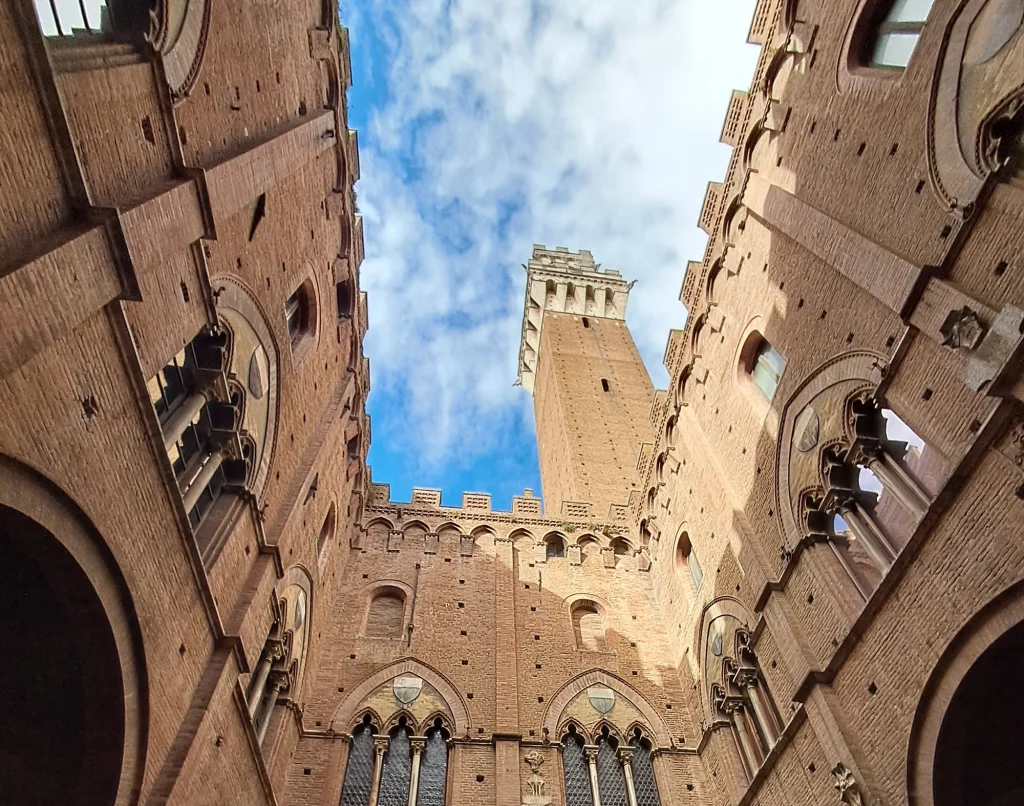
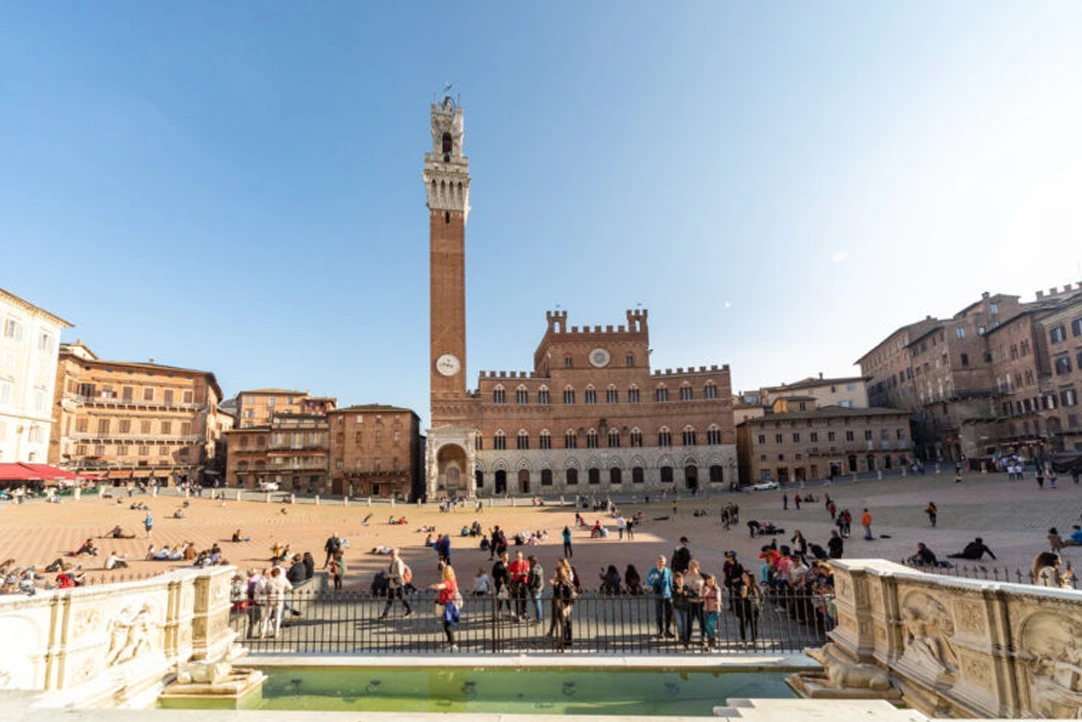
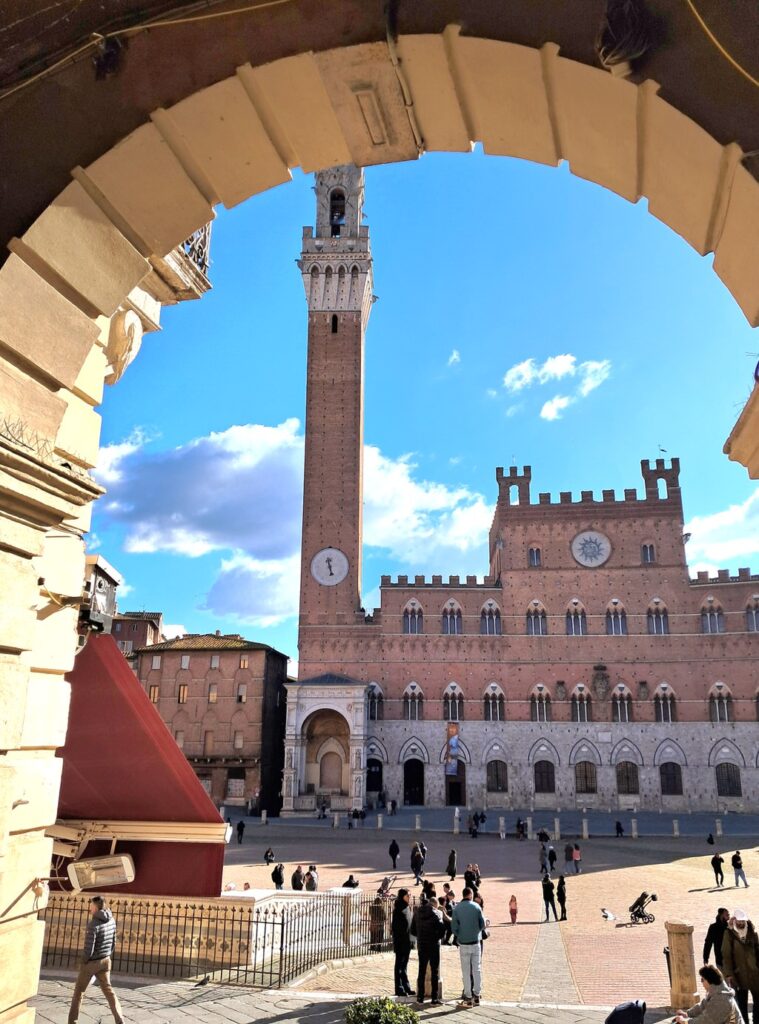
- Enter Piazza del Campo from its north side. Suddenly, Siena’s magnificent Campo opens up before you . This shell-shaped piazza, with its sloping red-brick floor and encircling medieval palazzi, is one of the world’s great public spaces. Directly opposite you towers the Torre del Mangia, the slender 102m bell tower of the Palazzo Pubblico (Town Hall). It’s an irresistible stop – take a few minutes (or as long as you like) to absorb it. Perhaps walk toward the center to the Fonte Gaia (a marble fountain, a replica of the 15th-c original). Piazza del Campo is the very track where the Palio race is run – imagine it packed with dirt and tens of thousands of spectators on race day . If it’s not too busy, stand in the middle and do a 360° turn to spot all 17 contrada emblems on the Palazzo Pubblico façade.
Point of Interest: On the south side of Piazza del Campo, you’ll notice a large stone building with arches – that’s Palazzo Pubblico, home to Siena’s city council and the Museo Civico (with famous frescoes inside) . To your left (east) of Palazzo Pubblico, there’s a smaller archway leading out of the Campo – that’s where you’ll be heading next.
- From the Campo, take the exit at the southeast corner, to the left of Palazzo Pubblico. This will put you onto Via del Porrione (also known as Via San Martino). You’ll know you’re on the right track if almost immediately on your right you see the facade of the Church of San Martino . This 16th-century church (with earlier roots) is the parish church of the neighboring contrada of Nicchio (Shell), but it’s a landmark on our route. Its Baroque façade and the adjacent Logge del Papa (a Renaissance loggia with columns) are worth a peek .
Continue straight past San Martino, along Via San Martino / Via del Porrione. After about 100 meters, you will come to Logge del Papa on your right – a graceful open-air loggia (built in 1462 by Pope Pius II) . Locals often hang out here. This loggia marks the heart of Leocorno territory – you’re now essentially in the Unicorn contrada.
- Just past the Logge del Papa, you hit a junction: straight ahead the street becomes Via di Pantaneto, while to the left it continues as Via del Porrione. Turn left into Via Pantaneto, the main street running downhill. (If you see a restaurant “Osteria Le Logge” around here, that’s a good sign you’re at the right junction.)
- Now you are definitively on Via di Pantaneto, which is the spine of Contrada del Leocorno. As you walk down Pantaneto, notice the Unicorn contrada colors and symbols on the walls – likely ceramic plaques of unicorns, flags hanging, or even murals. About 50 meters down on your left, look for a niche in the wall with columns and a basin – that’s the Fontanina del Leocorno (Fontana di Pantaneto) , the unicorn fountain we discussed and pictured earlier. It might be slightly recessed and easy to miss, but keep an eye out for unicorn motifs or a round plaque. This is where contrada baptisms happen, and it’s a key landmark. It usually has the contrada coat of arms (a unicorn) above the spout. Feel free to step in and take a photo (it’s a public fountain, though not for drinking nowadays).
- A few steps past the fountain, on your right will be a small opening – Piazzetta Virgilio Grassi. Turn right into this piazzetta. You’ll see the stone facade of a small church with a unicorn emblem – that is San Giovannino della Staffa, Leocorno’s oratory and museum entrance . Congratulations, you’ve reached the core of Contrada del Leocorno! The museum entrance is often through a door to the side (Via di Follonica, 31, which intersects here) . If you see contrada members around, you can politely ask if the museum is open (or check the posted hours).
Piazzetta Grassi is a charming little square, often decorated with contrada flags. You might see a bronze or marble unicorn statue here or nearby – some contrade display a statue of their animal in their territory. Now you are literally standing in Leocorno’s home. The Hotel Minerva journey is complete!
Route 1 Summary: Hotel Minerva → Via Garibaldi/Diacceto → Piazza Salimbeni (Monte dei Paschi) → Banchi di Sopra/Sotto → Piazza del Campo (Torre del Mangia) → Via del Porrione/San Martino (Church of San Martino) → Logge del Papa → Via Pantaneto (Unicorn Fountain) → Piazzetta Virgilio Grassi (Leocorno Oratory & Museum) .
This scenic route let you see Siena’s showpiece (the Campo) and some major landmarks en route, making the cultural journey as rewarding as the destination. It’s a bit of a detour but highly recommended for first-time visitors.
Route 2: Direct Historic Route via Banchi di Sotto
If you prefer a route that goes more directly to Leocorno without looping by the Campo, Route 2 is a great option. It follows one of Siena’s main old streets and brings you through the heart of Unicorn territory more directly.
Distance: ~1.1 km (0.7 miles)
Time: ~15 minutes
Terrain: Slight uphill then level, then downhill into contrada; overall moderate.
Highlights: Piazza Salimbeni, Via Banchi di Sotto (shopping street), Logge del Papa, Pantaneto.
Directions:
- From Hotel Minerva, again start by walking up Via Garibaldi towards the center (same as Route 1, Steps 1–2). You will reach Piazza Salimbeni in 5 minutes and cross onto Via Banchi di Sopra.
- Continue along Banchi di Sopra through Piazza Tolomei onto Banchi di Sotto, just as in Route 1 (Steps 3–4 above).
- Here’s where Route 2 diverges: Instead of entering Piazza del Campo, you will bypass it. After Piazza dell’Indipendenza (with the brick arch), when you see Costarella rise on right into the Campo, stay on Via Banchi di Sotto which actually veers left around the Campo’s perimeter. Essentially, you’re skirting the Campo’s northern rim via the street called Via Rinaldini / Via dei Pellegrini / Via di Città (the name changes, but follow the natural continuation – there are signs pointing toward the Duomo which is further up Via di Città, but you won’t go that far).
- Walk about 150m along this street. You’ll pass the elegant Palazzo Chigi-Saracini on your left (home of Siena’s Music Academy) – notable for its curved facade following the Campo’s shape. Shortly after, you’ll reach a junction by a stone arch (Croce del Travaglio). Here, turn right down Via Rinaldini, which is basically a short connector that leads to Via Banchi di Sotto again (just a lower portion of it). You might see a sign for “Pantaneto” pointing that way.
- Via Rinaldini slopes down and in a few steps you come to an intersection of several streets by the Logge del Papa (again). Now you’re effectively in the same spot as Route 1 Step 6: San Martino church will be just to your left, Logge del Papa on your left front, and Pantaneto straight ahead.
- Proceed straight onto Via di Pantaneto, entering Leocorno’s territory as described before. (You basically cut out going into the Campo by using the parallel street.)
- Walk down Pantaneto, see the Unicorn Fountain on left , then turn right at Piazzetta Virgilio Grassi to reach the Museum/Oratory .
This route is a bit faster and still full of interesting sights. You miss standing in the Campo, but you save several minutes. If time is short or Piazza del Campo is something you’ve already visited earlier, this direct path is efficient.
Route 2 Summary: Hotel Minerva → Via Garibaldi → Piazza Salimbeni → Banchi di Sopra/Sotto → (skirt around Piazza del Campo via Via Rinaldini) → Logge del Papa → Via Pantaneto → Piazzetta Virgilio Grassi (Leocorno).
Both routes converge at Logge del Papa and Via Pantaneto, so the final leg through Leocorno’s streets is the same.
Points of Interest Along Pantaneto (common to both routes): Via Pantaneto itself is worth strolling even beyond the fountain. It’s a lively street, popular with locals and students from the nearby University of Siena campus. You’ll find local eateries, wine bars, and pastry shops here. For example, you might pass Pasticceria Peccati di Gola (for delicious ricciarelli almond cookies) or some artisan boutiques. The street name “Pantaneto” means “little swamp” – historically this area was lower and prone to water, but now it’s fully urbanized.
One block past Piazzetta Grassi (further down Pantaneto) is the medieval Palazzo delle Papesse (not to be confused with the Logge del Papa) and the Fonte di Follonica, the medieval well spring now restored . You can peek into the Follonica valley if you venture that way (it’s slightly off to the east down some steps). This valley is the one Leocorno rehabilitated as their open space. It’s mostly a local secret spot with greenery and occasionally art installations (they inaugurated a “Unicorns’ Valley” sculpture project there).
For a casual explorer, walking the length of Pantaneto from one end (near Piazza di Porta Romana, where a city gate stands) to the other (Logge del Papa) gives a great feel of a contrada neighborhood – one end you have a city gate, at the other you connect to the Campo, and in between is the life of the Unicorn.
Using a Map: The streets in Siena can confuse first-timers, but locals are friendly if you need directions. Simply asking “Logge del Papa?” or “Via Pantaneto?” will usually get you a finger pointed the right way. Many streets have multilingual signs for major spots (e.g., “Museo Contrada Leocorno” might be indicated).
If you get a map from Hotel Minerva’s reception, locate Via Garibaldi (hotel), Via Banchi di Sotto, Piazza del Campo, and Via Pantaneto – then trace accordingly. The key is that Leocorno is just south-east of Piazza del Campo, so one way or another, you head towards the Campo and then go east/downhill.
Walking Back: From Leocorno back to Hotel Minerva, you can reverse these routes. If it’s later in the evening, note that Via Garibaldi is a bit quieter; you might prefer to return via the busier streets (Via di Città or via the Campo) for ambiance and lighting. Siena is generally safe, but it’s always nice to walk where there are other people around, especially at night. The hotel is slightly downhill from the very center, so the good news is the walk back to Minerva is mostly downhill or flat, making it easier on the legs after a day of exploring.
Alternate Options: Should you be tired or short on time, you can catch a local mini-bus. The Siena Mobilità Pollicino buses (small orange buses) run through the center. For example, route S3 goes from near Piazza Indipendenza down along Via Pantaneto and can drop you very close to Piazzetta Grassi , and another route can take you back up near Via Garibaldi. However, given the short distance, most visitors find walking more straightforward than deciphering bus routes in the maze-like streets (buses have to loop around due to many pedestrian zones).
Taxi: If needed, a taxi from Hotel Minerva to near Pantaneto would be a 5-minute ride. But again, walking is the quintessential way to enjoy Siena.
In conclusion, using Hotel Minerva as your base, you have easy access to Contrada del Leocorno: a pleasant stroll through historic streets. En route you’ve encountered Siena’s banking history, its main square, and finally stepped into the Unicorn’s realm. Now you can reward yourself by perhaps visiting a trattoria in Leocorno’s district (there are several on Pantaneto and nearby – you might dine literally in the contrada’s territory, which is a fun fact to share: “We ate dinner in the Unicorn contrada!”).
Before wrapping up, let’s provide a quick reference of key locations and their distances from Hotel Minerva:
- Hotel Minerva to Piazza Salimbeni (City center) – ~500 m (~6-8 minutes) .
- Piazza Salimbeni to Piazza del Campo – ~400 m (~5 minutes) .
- Piazza del Campo to Logge del Papa (Leocorno boundary) – ~200 m (~3 minutes).
- Logge del Papa to Leocorno Museum (Piazzetta Grassi) – ~100 m (~2 minutes).
- Hotel Minerva to Leocorno Museum (entire route) – ~1.3 km (~15-20 min) as detailed.
Use the above as a guide – times can vary if you window-shop or stop for photos (which you absolutely should!). Siena’s beauty is in wandering without rush.
Maps and Orientation in the Historic Center
Navigating Siena can feel like stepping back in time – the street layout is medieval, which means it isn’t a perfect grid. Here are some map tips and orientation pointers specifically for finding your way to and around Contrada del Leocorno:
- City Map: Obtain a free tourist map (often available at Hotel Minerva’s front desk or the Tourist Information Office). Locate Piazza del Campo (the heart of town) on it – Leocorno’s contrada lies just to the south-east of the Campo. Look for street names like Via Pantaneto, Via del Porrione, Via di Follonica on the map – that cluster is the Leocorno area . Mark Hotel Minerva on the map (Via Garibaldi on the north side). Visualize a route from the hotel towards the Campo, then hooking around into Pantaneto.
- Contrada Boundaries: On some maps or even on walls in Siena, you’ll see contrada boundaries indicated. The Leocorno contrada’s borders were defined by an 18th-century edict (the Bando of 1730 by Violante of Bavaria) . Essentially, the orange line in the earlier embedded map【31†(image)】 shows Leocorno’s territory: it includes Via San Vigilio and Via Sallustio Bandini at the north end (near Salimbeni), down Banchi di Sotto, encompassing Logge del Papa, Via del Porrione/San Martino (but note: the San Martino church itself belongs to Nicchio contrada, interestingly), then Via Pantaneto, Via di Follonica, and back up around some alleys. If you are interested, contradaioli can even show you the exact boundary markers (often a metal plate on the ground or a symbol on a wall where their contrada meets another). For example, near Logge del Papa you might find a marker where Leocorno meets Nicchio and Valdimontone contrade.
- Street Sign Colors: Siena has a charming system: each contrada often paints its colors on the corner street name plaques within its territory. In Unicorn contrada, you might notice the street signs on the walls have white-orange-blue stripes or a little unicorn emblem. As you leave that area, suddenly signs might show a different color scheme (when you enter, say, Torre or Nicchio contrada next door). This is a subtle way the contrade mark their turf and can be a fun treasure hunt to observe.
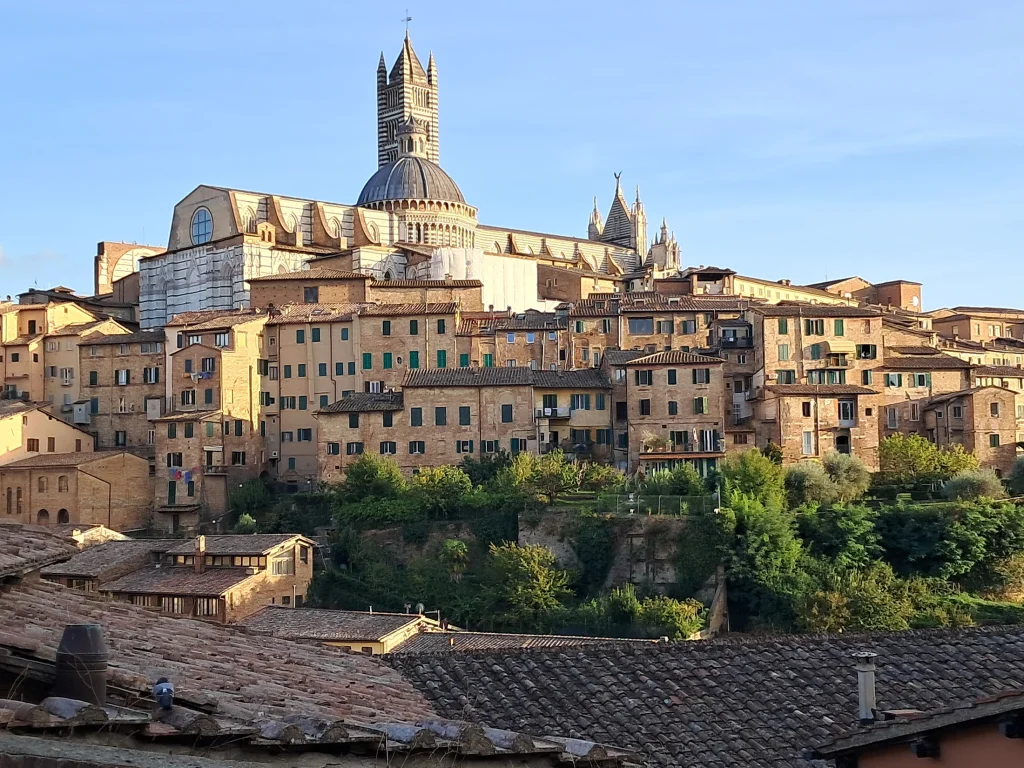
- Landmarks: Use tall landmarks for orientation. The Torre del Mangia is visible from many points – if you head toward it, you’re going towards the Campo. For Leocorno specifically, the dome of Siena’s Cathedral (Duomo) is a bit to the west; not directly relevant, but the Church of San Martino’s bell tower is a local landmark that basically sits at Leocorno’s border. Also, listen: you might hear drum practice or contrada songs from Pantaneto in evenings – follow the sounds of the unicorn!
- GPS and Apps: Modern convenience – you can use Google Maps or similar on your phone (offline maps recommended as the cell signal can be spotty in alleys). If you type “Museo Contrada Leocorno” it will pin the location. But sometimes GPS will have trouble in narrow streets; it may show you bouncing through buildings. Don’t worry – just get to the general area (Logge del Papa / Pantaneto) and then ask a local or look for the obvious signs (unicorn symbols). The museum entrance on Via di Follonica 31 might be modest, but usually there’s a flag or sign when it’s open.
- Illustrated Map: In case you find an illustrated tourist map, look for the unicorn icon – many maps of Siena indicate contrada districts with their mascot. Leocorno’s unicorn might be drawn somewhere between Piazza del Campo and Porta Romana on such maps.
- Porta Romana: As a reference point, Porta Romana (one of the old city gates) is at the far southern end of Via Pantaneto. If you walked down Pantaneto and kept going out that gate, you’d leave the city. So, Leocorno lies roughly between the Campo and Porta Romana, along that axis.
Lastly, it’s worth mentioning that part of the adventure is getting a little lost and stumbling onto hidden corners – Siena almost encourages it. Don’t be afraid to explore a side alley, you often find a quiet courtyard or a beautiful view. The good news: within the historic center, you’re never more than a kilometer or two from any other point. So even a “wrong turn” quickly becomes a “happy detour” (and maybe you’ll wander into another contrada’s territory briefly – just don’t tell Leocorno!).
Now that you’re armed with knowledge and directions, you should feel confident to set out from Hotel Minerva and immerse yourself in the Contrada del Leocorno. In the final section, we’ll address some Frequently Asked Questions (FAQ) that many tourists have about visiting contrade and Siena, to clear up any remaining curiosities or concerns.
FAQ: Frequently Asked Questions about Visiting Contrada del Leocorno
Q: Can I visit the Contrada del Leocorno’s headquarters and museum? Is it open to the public year-round?
A: Yes! The Museum of Contrada del Leocorno (with the oratory of San Giovannino) is open to visitors on a regular schedule. From Monday to Thursday 5:00–7:30 PM, and Friday/Saturday 10:00–12:30 and 5:00–7:30 PM, you can walk in without reservation . It’s closed to walk-ins on Sunday (and weekday mornings) but you can email to make an appointment if those are the only times you have . The contrada warmly welcomes tourists; the museum is free (a small donation is appreciated) . When you arrive at Piazzetta Virgilio Grassi 6, you’ll see signs or flags if the museum is open – just ring the bell or walk in, and a contrada member or guide will greet you. So, essentially, yes, it’s open most of the year, especially from spring through fall. Do note around Palio days or major holidays, hours might change, but generally it’s a year-round opportunity.
Q: Is the contrada’s inner hall (Società “Il Cavallino”) open to tourists?
A: The Società (social club) is primarily for contrada members and their guests. On ordinary days, it’s not a public restaurant or bar you can just drop into. However, during special events – like the pre-Palio dinners or the patron saint feast – the contrada society might open up its events to outsiders via tickets. For example, the Palio eve dinner often sells tickets to visitors (you usually purchase through someone in the contrada or an intermediary; sometimes your hotel can help). If you manage to get a ticket, you’ll be welcomed to dine at the contrada’s tables even though you’re not a member. Apart from such events, the interior spaces (like the bar or dining hall) aren’t generally touring spots. But don’t be discouraged: when the museum is open, you effectively see a good part of the contrada’s headquarters (the museum rooms and chapel). And contradaioli are friendly – if you strike up a conversation and express interest, you might be invited for a coffee or glass of wine at the society bar if circumstances allow. In summary: generally not open daily to the public, but accessible during events or by invitation.
Q: Are there any contrada events I, as a tourist, can attend or watch?
A: Absolutely! Many contrada events are public or semi-public. Here are a few you can definitely enjoy: – Open-Air Contrada Festivals: The Festa Titolare (patron feast around June 24 for Leocorno) includes public elements like street processions, flag throwing displays, and often an outdoor party with music. Tourists can watch processions and even join the crowd during the evening street celebrations. It’s a great time to be in Siena – you’ll find food stands, perhaps historical costume parades, etc., in the contrada’s streets. – Palio Trials and Corteo: If visiting during Palio (July 2 or Aug 16), you can attend the trial races (prove) for free in the Piazza del Campo (morning and evening for three days before the race). Leocorno will have its supporters cheering the trial runs. Also, the historical parade on Palio day is free to watch – grab a spot along Via di Città or in the Piazza. You’ll see Leocorno’s comparsa (group) marching in full regalia. – Blessing Ceremony: While the church is tiny and mainly for contradaioli, you can stand outside San Giovannino on Palio afternoon to observe the horse blessing from the doorway. Often a crowd of tourists and locals not of the contrada gathers quietly outside to catch a glimpse of the horse in the church – it’s unique to see. You won’t go inside, but being just outside, you can feel the emotion when the horse emerges to claps. – Contrada Dinners: As discussed, the big ones (Palio eve) you can attend by buying a ticket (ask your hotel or the Tourist Office well ahead of time – at least several days or weeks prior). Price might be around €50–€80 per person, which includes a full meal and wine – absolutely worth it for the cultural experience. Smaller weekly dinners are usually members-only, but if you have a local friend or make friends, you might snag an invitation. Siena is hospitable – I know stories of travelers who befriended a local in a café and ended up at a contrada dinner that night. – Museum Visits and Contrada Fairs: Sometimes contrade hold little art exhibits, presentations of books, or even food festivals open to all. Keep an eye on posters around town or the “Visit Siena” events calendar. Leocorno might, for instance, host a visiting choir in their church or a charity bake sale in the street – these are ad hoc, but if you stumble on one, feel free to join in. In short, yes, tourists can partake in several events – just be respectful and follow any instructions (e.g., if a dinner requires a ticket, don’t crash it without one; if a procession is passing, watch but don’t obstruct). The contrade know outsiders are curious, and they usually enjoy sharing their traditions as long as it’s done respectfully.
Q: What’s the best time of year to experience contrada life?
A: The peak is summer Palio season. Late June through mid-July, and again mid-August, Siena is buzzing with contrada activity. During these times, you can see rehearsals, open-air dinners, and of course the Palio itself. Specifically, June 24 (Leocorno’s feast) is great, and the days around July 2 and Aug 16, even if Leocorno isn’t racing, you’ll still see them out in full colors for the general atmosphere. If Leocorno is racing, the excitement is amplified – you’ll see their flags all over Pantaneto and hear nightly strategy meetings (not that you can join those, but the energy is palpable). However, other times have their charm too. In spring (April-May) and fall (September), contrade often have dinners or cultural events on weekends as the weather is pleasant. There’s also a lesser-known winter event: each contrada celebrates the Feast of the Contrada’s Patroness of the Fountain (La Festa della Madonna or similar) – for Leocorno, since their patron is a male saint, they might have a day for the Madonna as protector of the fountain (some contrade do this in early September). These are more internal, but you might still catch a low-key celebration. If I had to pick, June and August give maximum opportunities for a visitor to see contrada life in action. But even in, say, October or December, the museum will be open and you might see a contrada assembly or kids playing in the courtyard. The city is quieter then, so you could have more intimate interactions (contradaioli have more time to chat when not in full Palio prep mode). So the answer: Summer for festivities, but year-round for museum and quieter authenticity. Avoid the week after Palio if you want to see Leocorno people – they might be recovering if they won, or laying low if not!
Q: Can I buy a contrada flag or souvenir? I’d love to support Leocorno!
A: Yes, indeed. Most contrade have their own small souvenir shop or selling point (often run at the museum or at events). Leocorno likely sells items like silk scarves (foulards) in contrada colors, flags, pins, t-shirts, ceramic plates with the unicorn emblem, etc. When you visit the museum, ask if they have souvenirs for sale. Often they do, or they’ll direct you to someone who handles merchandise. Prices for a scarf might be around €15–€20. Wearing a contrada scarf is a sign of support – just remember, don’t wear a Leocorno scarf if you then wander into their rival’s territory (Civetta) and boast. But generally, as a tourist, it’s fine; locals know visitors often collect all 17 contrada flags as fun. There are also some stores in town (for example near Piazza del Campo) that sell all contrada flags and gadgets – these are official licensed products and a portion goes to the contrade. Buying direct from the contrada is nicest, though, as you often get a better story to go with it. So yes, feel free to proudly purchase and sport a Unicorn contrada flag or hanky – it makes a great memento of your Siena trip and supports the contrada’s activities.
Q: Is it appropriate to take photographs or video in the contrada, or during events?
A: Generally, yes, photography is welcome, but with some caveats: – In the museum and oratory, ask the guide about photos. Many contrada museums allow non-flash photography of the banners and rooms (some do not allow photos of certain sacred art). If there’s a no photo sign, respect it. But often you can snap a few pictures of the Palio banners for personal memory – just no flash to protect the art. – During outdoor events (parades, flag throwing, open dinners), photographs are fine. Locals expect tourists to take pictures of the colorful costumes and drums. They might even pose if you ask politely. Just don’t get in the way of performers. If a street is narrow and drummers are coming, don’t block them for a shot – stand aside and capture from there. – During solemn moments (like the horse blessing in the church, or a prayer), refrain from intrusive photography. For instance, if you peek into the church during the blessing, it’s not the moment for a selfie or flash photo – it’s a quiet ceremony. If you must, take one discreet photo without flash from outside. – Personal interactions: If you snap a candid of contradaioli chatting or kids playing in contrada outfits, that’s usually fine – these scenes are common in travel photography. If you get a chance, you might show them the photo and share a laugh or email it to them – it can be an icebreaker. – A very specific tip: If by chance you attend a contrada dinner as a guest, you can take photos of the environment (tables, flags, happy crowd). But if there’s a moment where they, say, sing the contrada anthem and a few have tears in their eyes, be sensitive and maybe don’t shove a camera in faces then. Enjoy the authenticity without turning it all into a photo-op. In summary, be respectful and use common sense. Most contradaioli are proud when tourists find their traditions photo-worthy – after all, the flags and costumes are stunning. They just appreciate respect for the intimate or sacred moments.
Q: Why is it called “Leocorno” and not just “Unicorno”? Is there a story behind the name?
A: “Leocorno” is an old Italian (and specifically Tuscan) word for “Unicorn.” It comes from Latin leucornus or elicornus, meaning one horn. In the Sienese dialect centuries ago, “Leocorno” was the term used – you can think of it as archaic Italian. So, it’s essentially the same creature. Some speculate “leo-” might relate to “lion” (since a unicorn has a bit of a lion-like tail or mane), but officially the symbol is the mythical unicorn. The contrada was historically referred to by this name as early as records exist. There isn’t a separate legend of a local unicorn encounter or anything – rather, it was chosen likely for the virtues the unicorn represents (purity, strength, the power to heal, as noted by the motto). The unicorn was also featured in many medieval coats of arms in Europe, symbolizing untamable nature and divine grace. For Siena, each contrada chose symbols often tied to either local landmarks or heraldic fashion of the time. Leocorno might have been inspired by a heraldic unicorn on a noble family’s emblem in that quarter. But no one calls it “Contrada dell’Unicorno” – always Leocorno. If you speak Spanish or French, note they say Unicornio or Licorne for unicorn – you can see the similarity. So the name is basically a linguistic quirk of old Italian. For practical purposes, just know Leocorno = Unicorn.
And indeed, the contradaioli will sometimes refer to themselves as Il Leocorno (masculine) or la Contrada del Leocorno. If you said “Unicorno,” they’d understand, but it would sound a bit off, like saying “the Unicorn district” in English. Embrace the unique term! It’s part of Siena’s charm that even the Italian spoken in contrada context has old-fashioned words.
Q: If I’m in Siena and Leocorno isn’t running in the Palio, can I still cheer for them?
A: Sure! You can always support Leocorno in spirit. During a Palio, only 10 contrade race. If Leocorno is not participating in that edition, the contrada will be quieter around race day (perhaps focusing on helping an allied contrada or just observing). You won’t see Leocorno’s banner in the race procession or on the track unless they’re in. But you can visit their museum, talk to contradaioli about past victories, and maybe watch the race in the Campo or a bar – you could playfully root for Leocorno’s ally (Pantera or Tartuca) since contrada people do that. For example, in a race where Leocorno isn’t running, their contradaioli often side with Pantera or Tartuca if those are running – or they simply watch neutrally, or root against their rival Civetta if Civetta is running (old habits!). As a visitor, you’re free to pick a contrada to cheer each race. If your heart is set on Leocorno, you might be a bit disappointed if they’re not in the race, but use that time to learn more about their history in between races. And maybe plan a return trip when they do run! On years like 2022 when Leocorno ran (and won) in August, the joy spilled into the streets for days. So it’s a bit of luck. But regardless, the contrada exists 365 days a year, not just on Palio day – so there’s always something of Leocorno to experience, race or not.
Q: Any etiquette tips if I attend a contrada dinner or event?
A: Building on what we touched on: – Dress code: Informal, but respectful. Smart casual is fine; no need for suit and tie or heels (it’s often on cobblestone streets). Avoid overly revealing clothing at a church event. Contrada scarves are usually worn by members, but if you bought one and you’re at their dinner, you can wear it – they’ll likely applaud your support. – During the meal: They may sing songs (including a rousing contrada anthem where everyone stands). If you don’t know the words, just stand and soak it in. Applaud after. They might do brindisi (toasts) – you can join lifting your glass and shouting “Viva (evviva) Leocorno!” along with them. – Greetings: If introduced, a simple “Piacere, I’m [Name] from [Country]” works. Many contradaioli speak some English, especially younger ones. Express your admiration for Siena or the contrada; they love that. E.g., “Thank you for having us, it’s an honor to be here.” goes a long way. – If the rival is mentioned (Civetta): You might hear some good-natured jabs about them. As a newbie, probably best to just smile. Don’t inadvertently praise Civetta in a Leocorno gathering – that’s one faux pas to avoid. (It’d be like cheering for the Red Sox at a Yankees bar or vice versa.) – Be open: They may be as curious about you as you are about them. Don’t be surprised if someone asks why you know about contrade or how you found the dinner. They’re genuinely happy when foreigners take interest, as long as you show genuine respect. – Payments: If it’s a paid dinner, you likely paid in advance. If it’s a free invite, perhaps offer to buy a round of drinks or at least thank your host profusely. There is no expectation for extra tipping at contrada events. – Photography at dinner: It’s generally okay, but again during the anthem or a prayer (they sometimes say grace before eating), put the phone down. In essence, follow the locals’ lead, show enthusiasm and respect, and you’ll be embraced as a friend.
We hope this extensive guide gives you all the tools and inspiration you need to explore the Contrada del Leocorno in Siena. From its mythic unicorn emblem and centuries of history , to the vibrant traditions that continue to this day, Leocorno offers a truly enriching experience for any visitor. By starting your journey at Hotel Minerva and walking these ancient streets, you’ll connect with the living fabric of Siena – and perhaps carry a bit of the Unicorn’s magic with you when you leave. Enjoy your travels in Siena, and viva il Leocorno!